Photoelectric Sensor Types and How to Choose: Through-Beam vs. Retro-Reflective vs. Diffuse-Reflective
Whether boxes or parts are present on a conveyor is, in many cases, checked by photoelectric sensors. However, photoelectric sensors come in several types, and if the type does not suit the workpiece, the sensor may work in the trial run but start missing workpieces once production begins. This article introduces the differences between the three basic types and how to think about choosing one.
What a photoelectric sensor looks at is “the change in the amount of received light”
A photoelectric sensor uses light to tell whether a workpiece is present. It can detect almost any object, including glass, resin, wood, and liquids.
Inside, it is broadly divided into three parts.
- Emitter: Emits light, mainly with an LED.
- Receiver: Converts the received light into an electrical signal.
- Amplifier unit: Compares how much light has been received (the amount of received light) with a threshold and switches the output ON or OFF. The threshold is the boundary value that separates ON from OFF.
The important point is that the sensor is not looking at the workpiece itself. What it looks at is the change in the amount of received light caused by the workpiece. In some types the amount of received light “decreases” when a workpiece arrives, and in others it “increases.” This difference determines each type’s strengths and weaknesses.
Differences between the through-beam, retro-reflective, and diffuse-reflective types
The three types differ in where the emitter and receiver are placed and which light they receive.
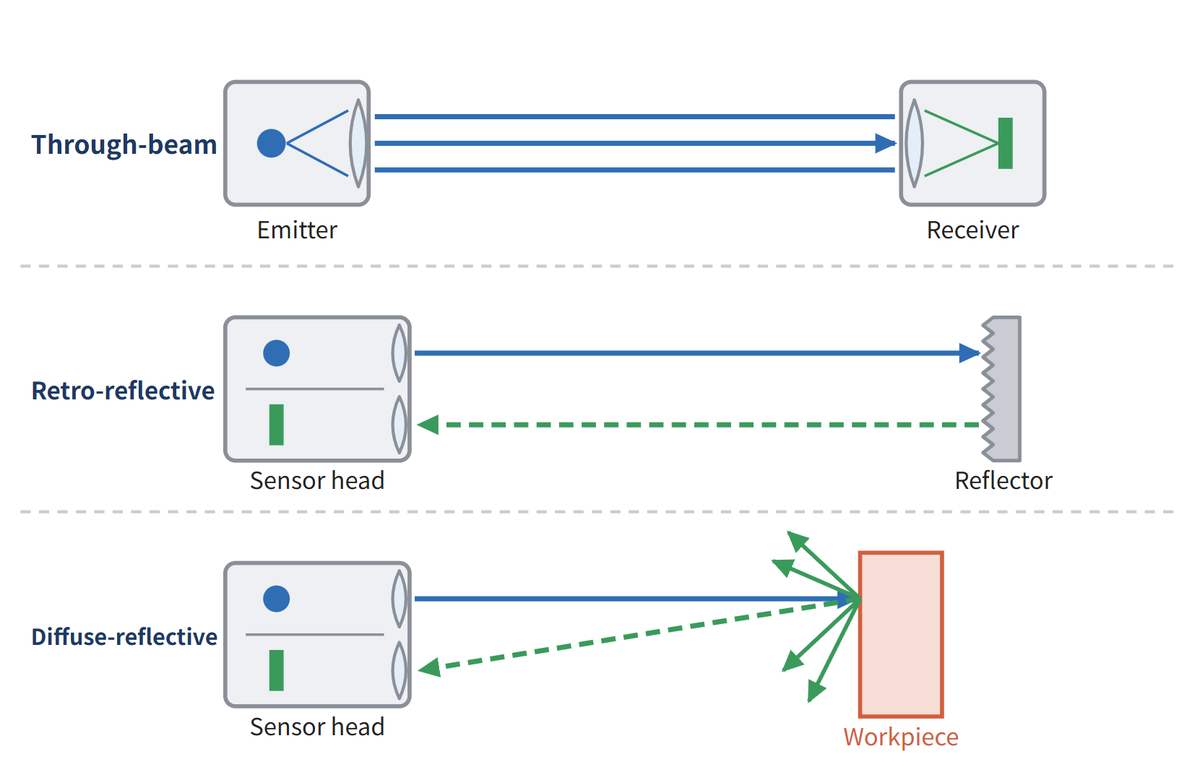
- Through-beam type: An emitter and a receiver are placed facing each other. When a workpiece blocks the light, the amount of received light decreases.
- Retro-reflective type: The emitter and receiver are housed in one unit, with a reflector placed opposite. When a workpiece blocks the light returned by the reflector, the amount of received light decreases.
- Diffuse-reflective type: Only one sensor is installed. When light scattered by the surface of a workpiece returns, the amount of received light increases.
| Method | When a workpiece arrives | Strengths | Watch out for |
|---|---|---|---|
| Through-beam | Received light decreases | Stable detection over long distances; for opaque workpieces, not affected by color or gloss | Transparent workpieces; needs space to mount two units facing each other |
| Retro-reflective | Received light decreases | Transparent workpieces; wiring on one side only, and easy optical axis alignment | Mirror-like workpieces |
| Diffuse-reflective | Received light increases | Needs only one sensor; the easiest to use | Black workpieces; bright backgrounds |
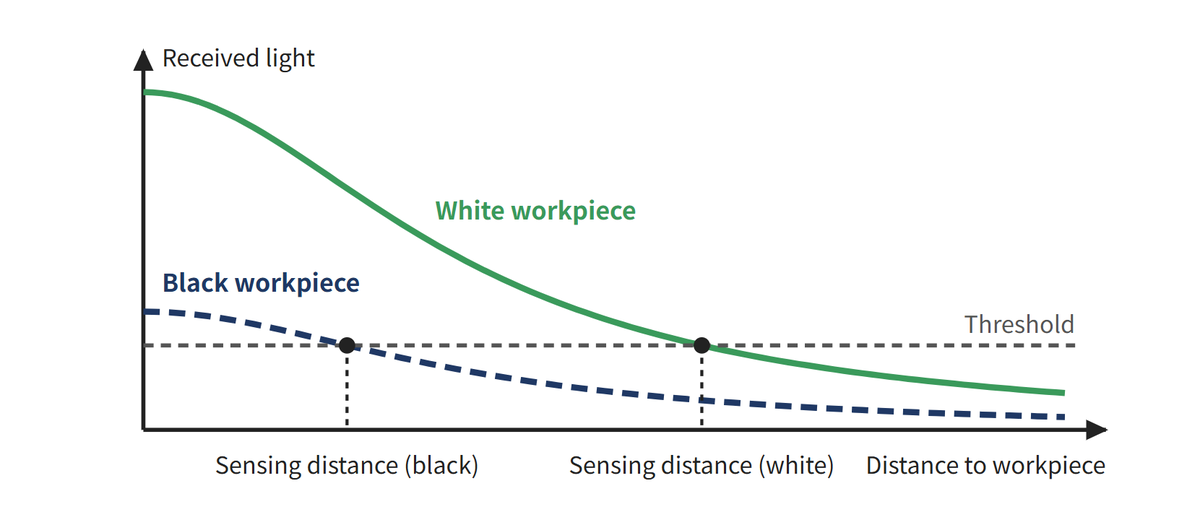
The through-beam type receives the light directly from the front, so it can get a large amount of received light. Its sensing distance ranges from a few cm to several tens of m, the longest of the three types.
Choosing by workpiece: transparent, black, and mirror-like workpieces
Each type’s weak points come from its detection principle. They are hard to overcome just by adjusting settings or mounting, so check the properties of the workpiece first. Note that a weak point does not mean “cannot be used.” It means the difference between with and without a workpiece tends to be small, so it needs to be checked.
- Transparent workpieces (such as glass bottles and clear containers): With a through-beam type, most of the light passes through, so the amount of received light decreases only a little. With a retro-reflective type, the light that passes through is returned by the reflector and passes through the workpiece again. The decrease is larger by that much, making the workpiece easier to detect.
- Black workpieces: With a diffuse-reflective type, only a little light returns from a black workpiece. The sensing distance on the specification sheet is measured with white paper, so a black workpiece can be detected only at a much shorter distance.
- Mirror-like workpieces (glossy items such as cans and batteries): A retro-reflective type judges “no workpiece” while it receives the light returning from the reflector, and “workpiece present” when a workpiece blocks the light and the amount of received light decreases. With a mirror-like workpiece, however, light specularly reflected by the workpiece surface returns to the sensor head just like the light from the reflector. The amount of received light does not decrease, so the sensor judges that no workpiece is present even though one is. Choosing a retro-reflective type with a polarizing filter reduces such detection errors.
- Small workpieces: With a through-beam type, they block only part of the light. Narrow the beam with slits, or consider a laser sensor.
When to use distance-settable types, laser sensors, and fiber optic sensors
When none of the three basic types fits, the following are also candidates.
- Distance-settable type: This type judges not by the amount of received light but by where the reflected light hits the light-receiving element. It is not easily affected by workpiece color and is unlikely to react to a background farther away than the set distance. It can be used even in front of a white wall or shiny metal. However, it handles extremely black objects and mirror-like objects poorly.
- Laser sensors: These are photoelectric sensors that use a semiconductor laser instead of an LED as the light source. The light stays narrowly focused and reaches long distances. They suit small workpieces, position detection, and aiming deep into a machine through a narrow gap. Check the hazard classification for the eyes (laser class) before use.
- Fiber optic sensors: They detect in the same way as photoelectric sensors and come in through-beam and reflective types. They suit narrow spaces and small workpieces.
The order for selecting, and the final check
To avoid choosing the wrong sensor, decide on the order of checks in advance: purpose, workpiece properties, distance and space, environment, speed, and output and wiring. Narrow down the type by the workpiece properties, and use the remaining conditions to decide the model and how to mount it.
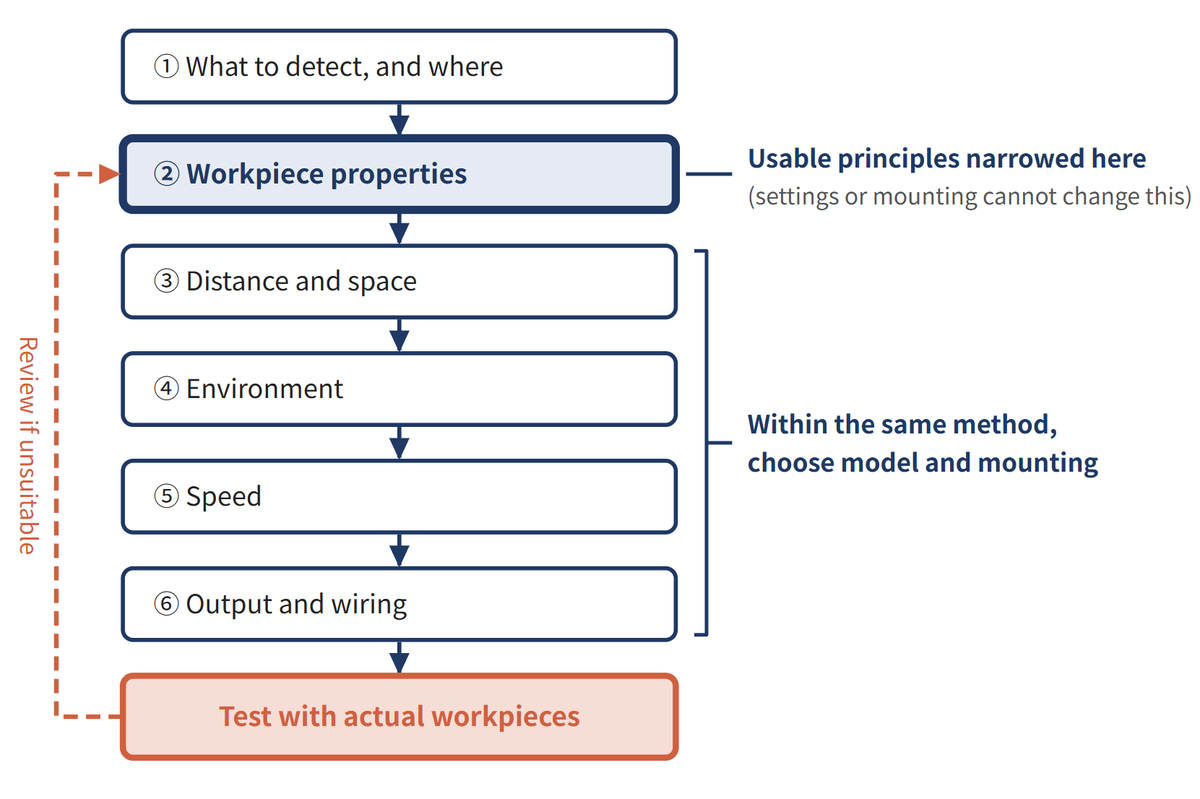
Once you have narrowed down the type and model, finally test with actual workpieces and the actual mounting. What you check is not just whether the output turns ON. Check how many times the threshold the amount of received light is, in other words, the excess gain.
If the excess gain is small, the sensor may work on the day you test it but later malfunction because of a dirty lens or a change in temperature. If the workpieces come in several colors, the trick is to test with the workpiece that is hardest to detect, such as the blackest one.
Summary
- A photoelectric sensor detects a workpiece by the change in the amount of received light. With the through-beam and retro-reflective types, the amount of received light decreases when a workpiece arrives; with the diffuse-reflective type, it increases.
- Use a retro-reflective type for transparent workpieces and a distance-settable type for black workpieces or bright backgrounds (check extremely black objects with the actual workpiece). For mirror-like workpieces, a retro-reflective type with a polarizing filter reduces detection errors.
- Narrow down the type by the properties of the workpiece, and finally test with actual workpieces to check the excess gain over the threshold.
Learn more: Official Handbook “FA Sensors: The Complete Guide — Basic”, Lesson 18 and Lesson 22
This topic is within the scope of the Basic Level exam of the Practical Sensor Certification.
You can look for photoelectric sensor products in Find Manufacturers (photoelectric sensors).