センサ実務検定協会™ Practical Sensor Certification Association Apply
English
The exam is planned to be offered in English, Traditional Chinese and Portuguese from February 2027. The Official Handbook (Basic Level) is now available on Amazon in English, Portuguese and Traditional Chinese (e-book); the Advanced Level is planned in Japanese for mid-December 2026.
Home / About the Exams
Certification / About the Exams

Prove your practical sensor skills at two levels

The Association conducts the Practical Sensor Certification, which assesses the practical ability to correctly select and use sensors and to deal with problems. With two levels, the Basic Level (Sensor Engineer Certification) and the Advanced Level (Sensor Specialist Certification), you can prove your skills step by step as your proficiency grows.

Levels / Two levels

The two levels of センサ実務検定™

The certification consists of two levels of different difficulty. The Official Handbook comes in two volumes, Basic Level and Advanced Level (11 chapters in total). The Advanced Level includes everything in the Basic Level, so you can step up to it directly.

Rear view of a person studying sensors at a desk at home with a laptop and a technical book
Basic Level | Sensor Engineer Certification

Understand the basics of sensors correctly

Your first step: this level covers everything from the basics of sensing to the principles of common sensors, measurement fundamentals and basic sensor selection exercises. Recommended study time: 1.5–2 months.

Recommended study time
1.5–2 months
Exam fee
US$39
Intended for
Sales staff at FA equipment trading companies and distributors, and at machine and equipment manufacturers; engineers currently active on the front lines of manufacturing; and people aiming to start a career in the FA industry or in manufacturing
Dates & Application
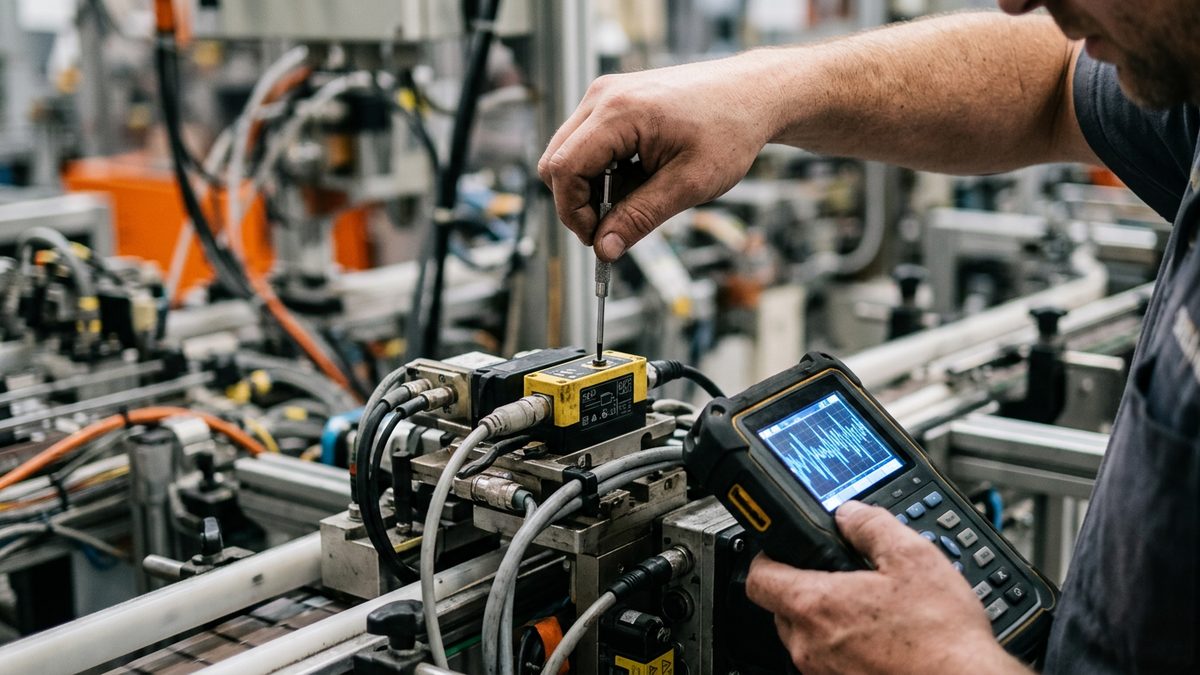
Close-up of a technician adjusting a sensor on a production line while checking waveforms on a handheld measuring instrument
Advanced Level | Sensor Specialist Certification

Going further into selection and troubleshooting

The higher level: in addition to everything in the Basic Level, it assesses how to deal with false detections on the shop floor, challenging detection tasks and the practical procedure for selecting sensors.

Recommended study time
About 2 more months after studying the Basic Level content
Exam fee
US$49
Intended for
Production engineering and quality assurance staff struggling with accuracy, engineers at machine and equipment manufacturers responsible for selection and commissioning, and those who have completed the Basic Level and are aiming to pass the Advanced Level
Dates & Application
Outline / Exam Overview

Practical Sensor Certification: Exam Overview

Outside Japan

Taking the exam from outside Japan (planned)

The exam is planned to be held in English, Traditional Chinese and Portuguese from the 1st exams in 2027 (February for the Basic Level, March for the Advanced Level), for both levels. The English exam follows the Japanese schedule, except in May, when it is held one week later. Other dates shown on this site are for the Japanese-language exam held in Japan.

Scope / Exam Scope

Practical Sensor Certification exam scope — all 11 chapters of the Official Handbook

The exam scope follows the chapter structure of the Official Handbook. The Basic Level covers the Basic volume (Chapters 1–6), and the Advanced Level covers both the Basic and Advanced volumes (Chapters 1–11).

Basic and Advanced LevelsOfficial Handbook: Basic volume

01
The Big Picture of SensorsWhat sensors do, their types, where they are used, and the basics of units and numbers
02
Reading SpecsSpec Sheets and Measurement Accuracy
03
The Physics Behind SensorsLight, light-emitting and light-receiving elements, optics; sound, ultrasound and heat; electricity and magnetism
04
Detection SensorsPresence and Pass/Fail
05
Measurement Sensors (1)Measuring Dimensions
06
Measurement Sensors (2)Measuring Other Quantities

Advanced Level onlyOfficial Handbook: Advanced volume

07
Achieving AccuracyError Sources and Countermeasures
08
Transferring ValuesOutput, Communication, and Wiring
09
ProtectingHarsh Environments and Machine Safety
10
ChoosingCombining Sensors and Sensor Selection
11
Keeping, Fixing, ReadingMaintenance and Quality Data
+
Chapters 1–6 (Basic Level volume)The Advanced Level exam also covers the Basic Level volume
Flow / How to Take the Exam

How to Take the Exam

Everything from application to certification can be done online.

  1. STEP 1 Apply

    Apply for the exam on the application page. An application period is set for each exam, and the deadline is 23:59 (Japan time) on the last day of the application period.

  2. STEP 2 Pay the exam fee

    Pay the exam fee on the application page. For the available payment methods, see “Payment methods” below.

  3. STEP 3 Take the exam online

    Take the exam on a computer at home or at work (you cannot take the exam on a smartphone or tablet). The recommended environment is explained on the application page. Before the exam, be sure to check the operating environment and how to answer with the “connection and operation test.”

  4. STEP 4 Results

    About one week after the exam, we will email you your result (pass or fail), together with your score and the passing score.

  5. STEP 5 Certification

    If you pass, you can log in to the exam site and download your certificate. You can also download a certification logo for business cards and more from this website.

Payment methods

* Because payment and its confirmation take several days, convenience store payment and bank transfer are not available from 14 days before the exam date (after that, please apply with a credit card or PayPal). Please pay within 7 days of applying. If payment cannot be confirmed by the deadline, your application will be cancelled automatically. Bank transfers take 1–3 business days to be confirmed. If you apply from outside Japan, you can pay by credit card or PayPal (residents of Vietnam can also use NgânLượng).

* Once you have applied, we cannot accept cancellations, date changes or refunds for personal reasons. For details, please see the Legal Notice under the Act on Specified Commercial Transactions.

Certification / About Certification

When you pass

Result notification: We will email you your result (pass or fail), together with your score and the passing score, about one week after the exam.

Certificate: If you pass, you can log in to the exam site and download your certificate. We do not issue or mail paper certificates, and we do not issue Open Badges.

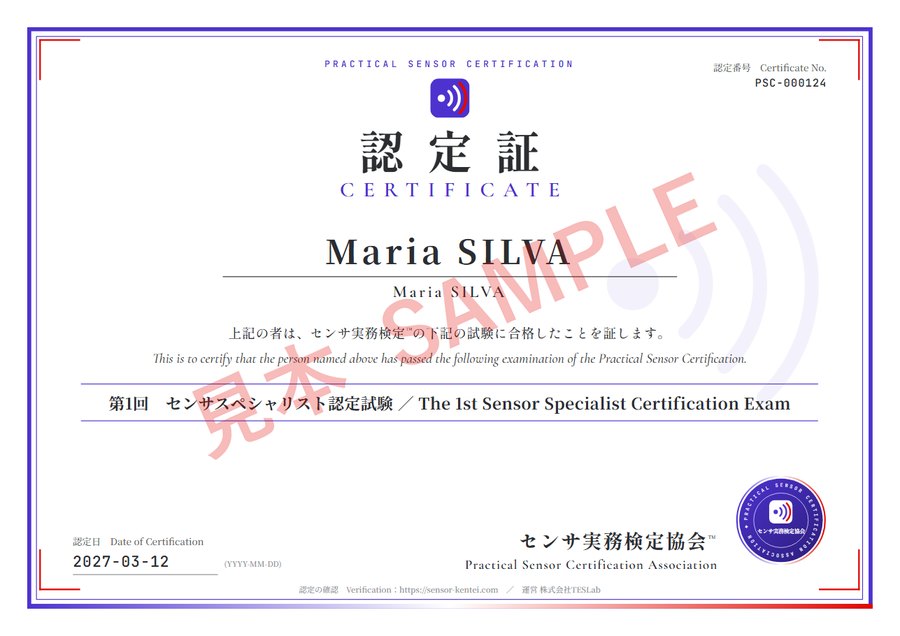
Certification logo: You can download a certification logo showing your certification number, for use on business cards, résumés, social media profiles and more. Anyone can confirm a certification from its number and the holder’s family name in Roman letters on the Verify a Certification page.

Sample Practical Sensor Certification certificate (Advanced Level; the name, number and date are fictitious)
Sample certificate (the name, number and date are fictitious. The design may change.)
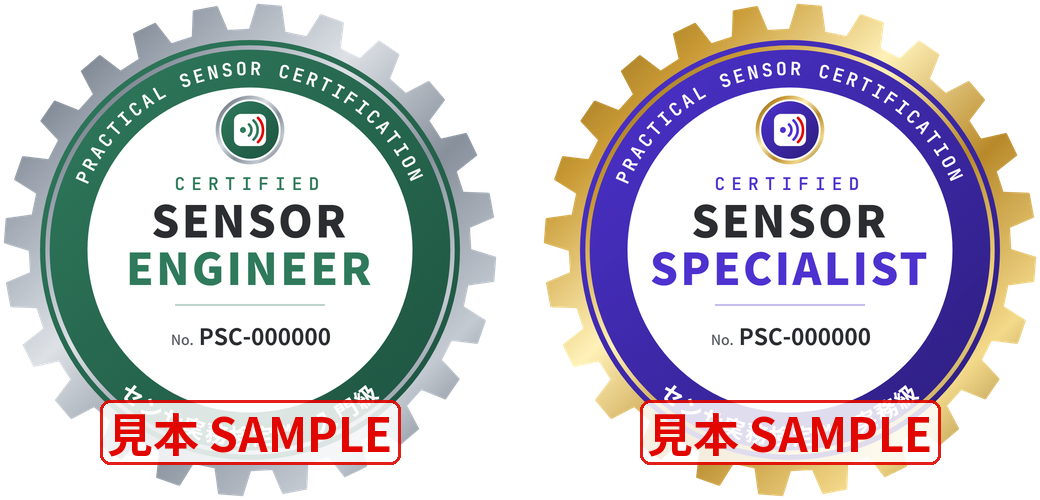
Sample certification logos (left: Basic Level, right: Advanced Level; the number is a sample)
Sample / Sample Questions

Sample questions

Sample questions close to the actual exam format let you get a feel for the level of the exam.

Basic LevelKnowledge

Sample question 1

Which of the following correctly explains why a retro-reflective photoelectric sensor is suited to detecting glass bottles and transparent containers?

  1. ABecause light specularly reflected from the surface of the workpiece returns directly to the sensor head
  2. BBecause part of the light scattered by the transparent workpiece returns, increasing the amount of light received
  3. CBecause the light returned by the reflector passes through the workpiece twice, causing a larger drop in the amount of light received
  4. DBecause it judges by where the reflected light lands on the light-receiving element
Show answer and explanation

Answer: C

In a retro-reflective sensor, light that has passed through the transparent workpiece is returned by the reflector and passes through the workpiece once more before returning to the sensor head. The light weakens each time it passes through, so the amount of light received drops more than with a through-beam sensor, where the light passes through only once. A is the reason mirror-like workpieces are difficult for retro-reflective sensors, B describes the diffuse-reflective type, and D describes how the distance-settable type detects.

Explained in: Official Handbook, Basic volume, Lesson 18 (18-3)

Basic LevelInterpretation & judgment

Sample question 2

Ever since the day a valve was closed suddenly, the zero-pressure reading of a pressure sensor on a pipe has stayed offset from 0 and has not returned. What is the most likely cause?

  1. AThe diaphragm is responding to pump pulsation, so the value fluctuates
  2. BThe surrounding temperature changed, and the zero point shifted temporarily
  3. CA surge pressure exceeded the proof pressure, and the diaphragm has not returned to its original shape
  4. DA fluid not compatible with the sensor corroded the wetted parts
Show answer and explanation

Answer: C

When a valve suddenly stops a flowing liquid, a brief high pressure (surge pressure, or water hammer) occurs. If the surge pressure exceeds the proof pressure, the diaphragm can no longer return to its original shape, and the zero point shifts or the sensor breaks, so replace the sensor and consider a type with a restrictor in the pressure port. Pulsation is a fluctuation in the value, which differs from a reading that stays offset. A shift caused by temperature disappears when the temperature returns, and corrosion does not explain why the problem began on the day the valve was closed suddenly.

Explained in: Official Handbook, Basic volume, Lesson 36 (36-6)

Advanced LevelInterpretation & judgment

Sample question 3

The height of a machined metal surface is being measured with a triangulation laser displacement sensor. When the workpiece is stopped, the reading is stable, but when it is measured while being fed, the variation becomes more than 10 times larger than when stopped, and the value differs depending on the position. Which is the most appropriate factor to suspect?

  1. ASensor noise added during photoelectric conversion in the light-receiving element
  2. BScanning resolution, caused by surface irregularities finer than the spot
  3. CLinearity, caused by the sensor’s internal characteristics
  4. DTemperature drift, caused by changes in the ambient temperature
Show answer and explanation

Answer: B

When the surface has irregularities finer than the spot, the light scatters in different directions from each slope, and the centroid of the received light shifts from place to place. This is scanning resolution: its hallmark is that the reading is stable when the workpiece is stopped, but varies and differs from place to place when the workpiece moves. Sensor noise appears even when the workpiece is stopped, and temperature drift is a slow shift over time. Linearity shows up when workpieces of different heights are measured.

Explained in: Official Handbook, Advanced volume, Lesson 40 (40-2)

* These sample questions are taken from the review questions and mock exam in the Advanced volume of the Official Handbook. They will not appear in the actual exam. “Explained in” shows the part of the Official Handbook that explains the content.

FAQ / Frequently Asked Questions

FAQ

Q.Is there a qualification or certification for sensors?

A.The Association’s Practical Sensor Certification assesses the practical ability to correctly select and use sensors on the manufacturing floor and to deal with problems. There are two levels, the Basic Level (Sensor Engineer Certification) and the Advanced Level (Sensor Specialist Certification), and all exams can be taken online.

Q.Is the Practical Sensor Certification a national (government) qualification?

A.No. The Practical Sensor Certification is a private certification run by the Practical Sensor Certification Association. It is not a national or other government-recognized qualification.

Q.Does the certification expire?

A.No. The Practical Sensor Certification certifies that, at the time of the exam, your knowledge and skills met a certain standard. There is no expiry date and no renewal procedure.

Q.What is the difference between the Basic Level and the Advanced Level?

A.The Basic Level is an entry-level exam covering everything from the basics of sensing to the principles of common sensors, measurement fundamentals and basic sensor selection exercises. The Advanced Level includes all of that content and is a higher level that also assesses how to deal with false detections on the shop floor, challenging detection tasks and the practical procedure for selecting sensors.

Q.Are there any eligibility requirements?

A.No. You can start with either level, and you can take the Advanced Level without having passed the Basic Level. If you are new to the subject, we recommend taking the Basic Level in February and the Advanced Level in May.

Q.How much is the exam fee?

A.The Basic Level is JPY 6,160 and the Advanced Level is JPY 7,480 (both including tax). If you live in Japan, you pay in yen (Basic Level JPY 6,160, Advanced Level JPY 7,480) regardless of which language page you apply from.

Q.When is the application deadline?

A.For the exam in Japan, the deadline is 23:59 (Japan time) on the last day of the application period. Application periods are set for each exam and announced on the Exam Schedule page. For the exam outside Japan, the deadline is 23:59 UTC on the last day of the application period.

Q.How can I pay the exam fee?

A.You can choose from credit card (VISA, Mastercard, JCB, American Express, Diners), convenience store payment in Japan (Lawson, Ministop, FamilyMart), bank transfer or PayPal. Because payment and its confirmation take several days, convenience store payment and bank transfer are not available from 14 days before the exam date (after that, please apply with a credit card or PayPal). Please pay within 7 days of applying. If payment cannot be confirmed by the deadline, your application will be cancelled automatically. Bank transfers take 1–3 business days to be confirmed. If you apply from outside Japan, you can pay by credit card or PayPal (residents of Vietnam can also use NgânLượng).

Q.Where can I take the exam?

A.All exams are held online. There are no in-person test venues. You can take the exam from home or work as long as you have a computer connected to the internet. Recommended system requirements will be provided on the application page.

Q.Can I take the exam on a smartphone or tablet?

A.No. The exam is designed to be taken on a computer, and we have not checked how it displays or works on smartphones or tablets, so it can be taken on a computer only. The required computer and network environment will be explained on the exam site (application page).

Q.How long is the exam, and what types of questions are there?

A.The exam lasts 60 minutes and has 50 questions: multiple-choice questions (four options) and questions where you enter a number or term (for both the Basic Level and the Advanced Level). In Japan, the exam is held twice a day, Session 1 (10:00–11:00) and Session 2 (14:00–15:00), Japan time, and you choose one of the two sessions. For the exam outside Japan, see “Taking the exam from outside Japan” above.

Q.What is the passing standard?

A.The passing score is determined for each exam session based on a score rate of approximately 70%, taking the difficulty of that session into account.

Q.Is there a limit on how many times I can take the exam?

A.No. Even if you do not pass, you can take the exam again as many times as you like, from the next session on.

Q.Can I take the exam from outside Japan?

A.Yes. The exam is planned to be available in English, Traditional Chinese and Portuguese from the 1st exams in 2027 (February for the Basic Level, March for the Advanced Level), for both levels. The exam dates are almost the same as in Japan; only the English exam in May is held one week later. Exam fees (in US dollars or Taiwan dollars) and exam times (in UTC) are given on the page for each language.

Q.How long do I need to study?

A.As a guide, the Basic Level takes 1.5–2 months of study, and the Advanced Level about 2 more months after you have studied the Basic Level content.

Q.What is the exam scope of the Practical Sensor Certification?

A.The exam covers all 11 chapters of the Official Handbook. The Basic Level covers Chapters 1–6 of the Basic volume (The Big Picture of Sensors, Reading Specs, The Physics Behind Sensors, Detection Sensors, Measuring Dimensions, Measuring Other Quantities). The Advanced Level covers both volumes: Chapters 1–6 plus Chapters 7–11 of the Advanced volume (Achieving Accuracy, Transferring Values, Protecting, Choosing, Keeping, Fixing, Reading).

Q.Are there any study materials?

A.The Official Handbook “FA Sensors: The Complete Guide” covers the exam scope, in two volumes (Basic Level and Advanced Level). The Basic Level is available on Amazon (English edition: Kindle and paperback). The Advanced Level is planned to be published in Japanese in mid-December 2026. The handbook is not included in the exam fee. For details, see the Official Handbook page.

Q.Who is the exam for?

A.As with the Official Handbook, it is intended for engineers currently active on the front lines of manufacturing, sales staff at FA equipment trading companies and distributors or at machine and equipment manufacturers, and people aiming to start a career in the FA industry or in manufacturing.

Q.Can I cancel or change the date after applying?

A.Once your application is complete, we cannot accept cancellations, date changes or refunds of the exam fee for the candidate’s own reasons. However, if an exam is canceled for reasons on the Association’s side or due to natural disasters, system failures, etc., the exam fee will be refunded in full. Please also see the Legal Notice under the Act on Specified Commercial Transactions.

Q.Can a company or school apply as a group?

A.Yes. Group applications are available for 10 or more people. Discounts on exam fees and the Official Handbook are available, and we can also discuss holding the exam on a date arranged for your group. For details, see For Companies & Schools.

Q.What happens if my connection drops or my computer stops working during the exam?

A.Candidates who fail because they could not show their true ability due to a poor connection, a system error, a computer malfunction, unfamiliarity with how to answer, or similar reasons can take the next exam once for free under the “retake program.” Eligible candidates will receive a coupon code that can be used only for the next exam. Requests must be made within one month of the exam date. How to make a request will be explained in the email notifying you of your results.

Q.Is there anything I should prepare before the exam?

A.Before the exam, be sure to take the “connection and operation test.” It lets you check your computer’s operating environment and how to answer the exam questions in advance.

Q.Can I use a calculator or take notes during the exam?

A.Yes. You may use a calculator and take notes, for example for calculation questions. However, during the exam you cannot leave the exam screen on the computer you are using, and you cannot right-click. If you need a calculator or writing materials, please have them ready separately from your computer. To prevent misconduct, we may change the exam rules in the future, for example by no longer allowing calculators or writing materials. If we do, we will announce it in advance.

Q.Is identity verified by camera or similar means?

A.We do not verify identity using a computer camera or similar means. Above all, the Practical Sensor Certification values candidates gaining correct knowledge themselves and turning it into skills that are useful on the shop floor. Please take the exam honestly, on your own ability. If any misconduct comes to light, the certification may be revoked. In the future, to prevent misconduct, we may introduce identity verification by camera or a system that checks how the exam is being taken. If we do, we will announce it in advance.

Q.Will I be told my score and the passing score?

A.Yes. In the result email sent about one week after the exam, we will tell you your score and the passing score along with your result (pass or fail).

Q.What do I receive if I pass?

A.You can log in to the exam site and download your certificate (we do not mail paper certificates or issue Open Badges). You can also download a certification logo for business cards, résumés, email signatures and more. Anyone can verify a certification using the certification number on the certificate and the holder’s family name (in Roman letters).

Q.Can I get a receipt?

A.Yes. You can log in to the exam site and download your receipt.

Q.When is the next exam?

A.The 1st exams in 2027 will be held on February 14 (Sunday) for the Basic Level and March 20 (Saturday) for the Advanced Level. In addition, the Basic Level is planned for May 16 and September 12 (Sundays), and the Advanced Level for May 23 and September 19 (Sundays). From November 2027, the Basic Level is planned to be held four times a year (February, May, September and November) and the Advanced Level three times a year (May, September and November, on the Sunday one week after the Basic Level). For the latest information, please see the Exam Schedule page.

TOP