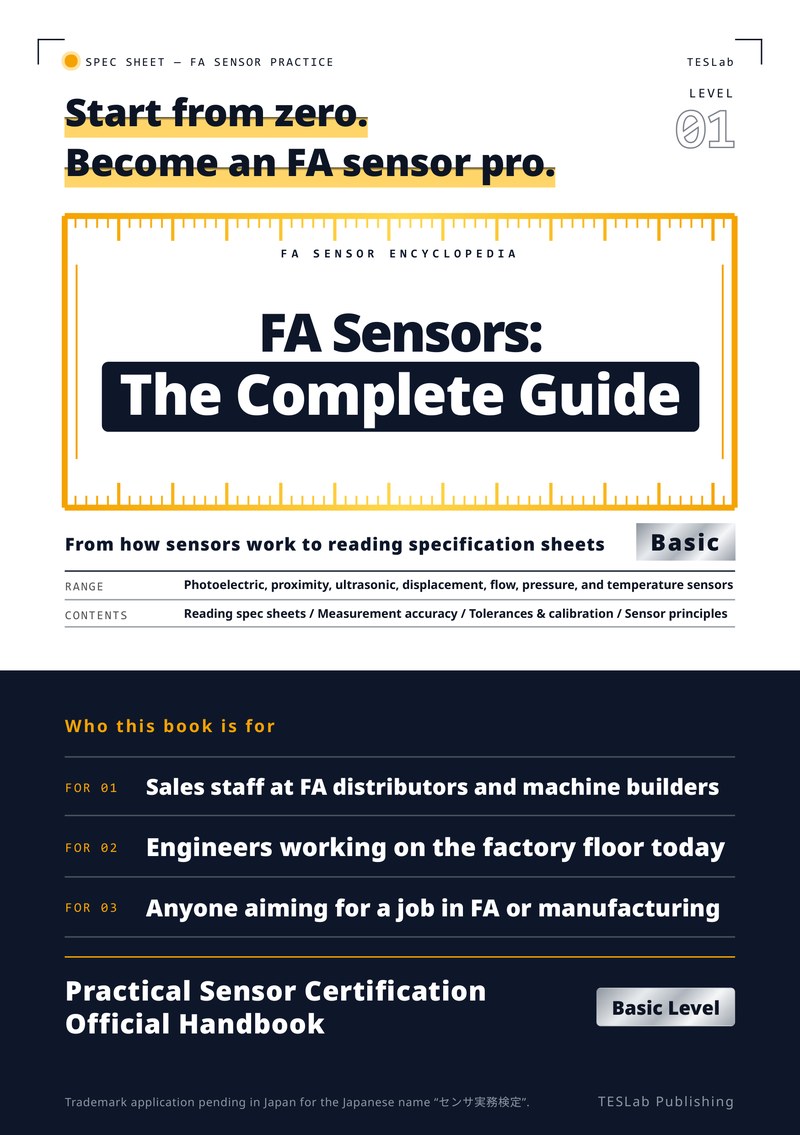
LEVEL 01|Basic Level
FA Sensors: The Complete Guide — Basic
Available now
Start from zero. Become an FA sensor pro.
From how sensors work to reading specification sheets
The gateway to sensor knowledge you can use — in this one book.
Who this book is for
- Sales staff at FA distributors and machine builders
- Engineers working on the factory floor today
- Anyone aiming for a job in FA or manufacturing
Factories rely on many kinds of sensors: photoelectric, proximity, laser displacement, flow, pressure, and temperature sensors. This book explains how they work and how to read their specification sheets. It moves systematically through four areas: the big picture of sensors, spec sheets and measurement accuracy, the physics behind sensors, and the principles of each sensor type, with many diagrams. If sensors and physics are new to you, this one book gives you the fundamentals that hold up on the factory floor.
- CH 01The Big Picture of Sensors
- CH 02Reading Specs — Spec Sheets and Measurement Accuracy
- CH 03The Physics Behind Sensors
- CH 04Detection Sensors — Presence and Pass/Fail
- CH 05Measurement Sensors (1) — Measuring Dimensions
- CH 06Measurement Sensors (2) — Measuring Other Quantities
Chapters 1–6 cover the exam scope of both the Basic and Advanced Levels.
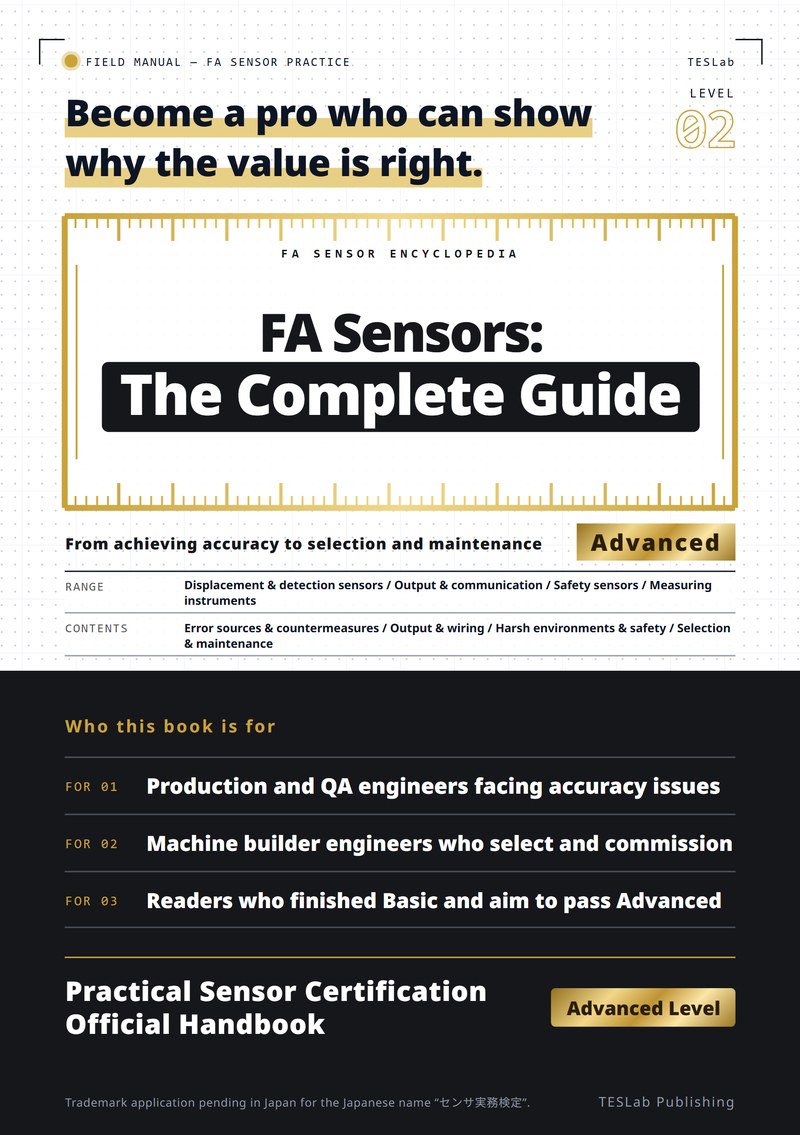
LEVEL 02|Advanced Level
FA Sensors: The Complete Guide — Advanced
Japanese edition planned for mid-December 2026
Become a pro who can show why the value is right.
From achieving accuracy to selection and maintenance
Real-world skills to master sensors — in one book.
Who this book is for
- Production and QA engineers facing accuracy issues
- Machine builder engineers who select and commission
- Readers who finished Basic and aim to pass Advanced
Factories rely on many kinds of sensors: photoelectric, proximity, laser displacement, flow, pressure, and temperature sensors. Building on the Basic Level volume, which covered how sensors work and how to read spec sheets, this book teaches the practical skills needed on site: achieving accuracy, transferring values, and protecting, selecting, and maintaining sensors. It moves systematically through error sources and countermeasures, output and wiring, harsh environments and safety, and selection and maintenance, with many diagrams. Through real cases, it helps you base on-site decisions about accuracy and faults on solid evidence.
- CH 07Achieving Accuracy — Error Sources and Countermeasures
- CH 08Transferring Values — Output, Communication, and Wiring
- CH 09Protecting — Harsh Environments and Machine Safety
- CH 10Choosing — Combining Sensors and Sensor Selection
- CH 11Keeping, Fixing, Reading — Maintenance and Quality Data
Chapters 7–11 cover the Advanced Level exam scope.